

Fluoroscopy

Imaging Technique | Clinical Applications | Role in Diagnostic Evaluation | Contrast Use and Procedure Flow | Clinical Value

Fluoroscopy is used to provide real-time imaging during diagnostic exams and image-guided procedures. Unlike static imaging modalities, it allows movement within the body to be observed directly, which makes it particularly useful when function and coordination need to be evaluated. Fluoroscopy exams are performed in hospital-based settings, where procedural support and coordination with referring providers can be accommodated.
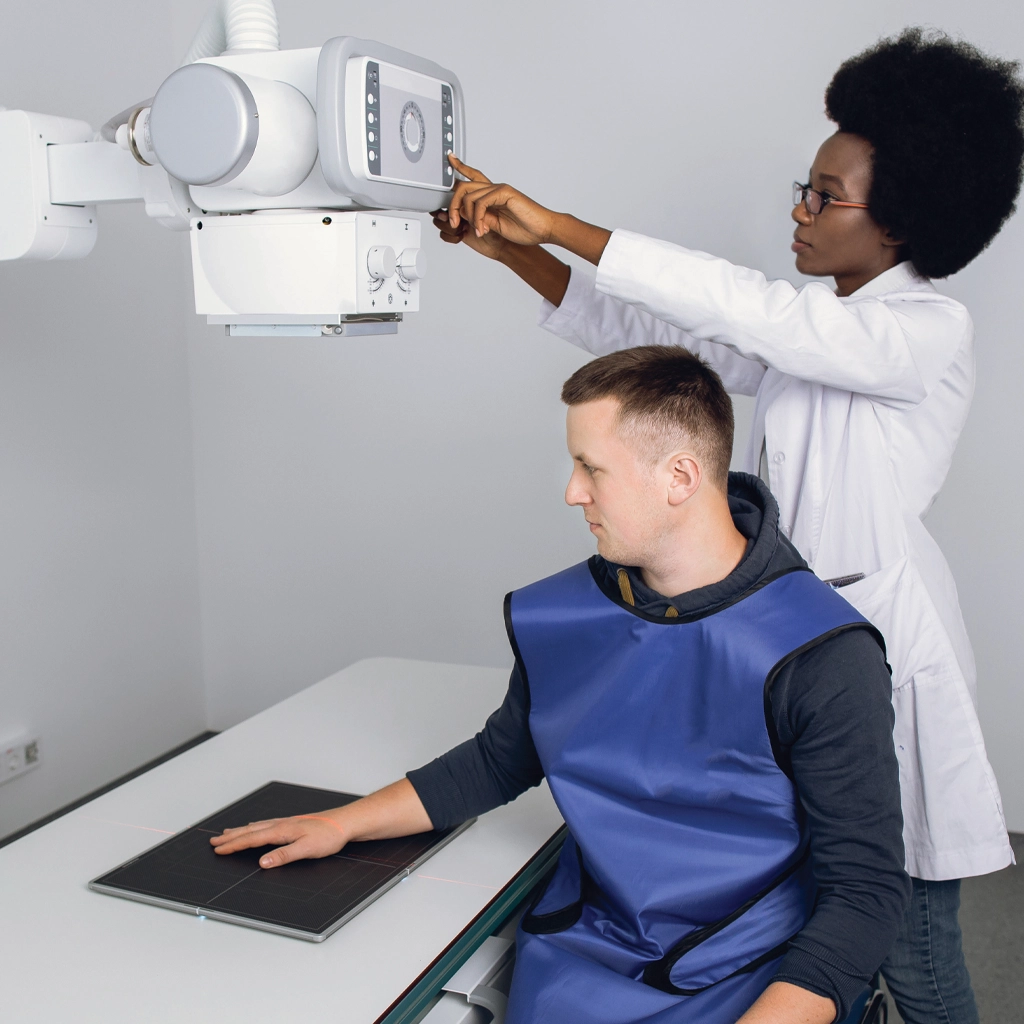

Radiography X-ray Films Fluoroscopy

Imaging Technique

Fluoroscopy uses continuous or pulsed X-ray imaging to produce live images that are displayed on a monitor. This allows structures to be visualized in motion rather than as a single captured image. Contrast agents are often used during fluoroscopic exams to outline specific anatomical structures and improve visualization.

Because imaging is performed in real time, positioning and technique can be adjusted throughout the exam. This flexibility allows the study to be tailored based on what is observed during the procedure, rather than relying entirely on predetermined imaging parameters.

Clinical Applications

Fluoroscopy is commonly used to evaluate the gastrointestinal tract, including esophagrams, upper GI series, and small bowel follow-through exams. These studies assess how contrast material moves through the digestive system, allowing evaluation of swallowing, motility, and structural abnormalities.

It is also used in the evaluation of the urinary system, including voiding cystourethrograms, in which bladder function and urine flow are assessed dynamically.

In musculoskeletal applications, fluoroscopy supports image-guided procedures such as joint injections, aspirations, and other interventions that require precise needle placement. Real-time visualization helps confirm accurate positioning and delivery during these procedures.
Fluoroscopy may also be used in other diagnostic and procedural settings where motion or positioning is a key component of the evaluation.

Role in Diagnostic Evaluation

Fluoroscopy is typically selected when understanding movement or function is necessary to answer the clinical question. While CT and MRI provide detailed structural information, they do not capture real-time motion. Fluoroscopy addresses this by allowing direct observation of how structures behave during an exam.

In gastrointestinal imaging, for example, it allows evaluation of swallowing mechanics and contrast material transit, which cannot be assessed with static imaging. In procedural settings, it provides immediate confirmation of instrument placement and technique.

Because of its interactive nature, fluoroscopy exams often involve adjustments during the study to capture the most clinically relevant information.

Fluoroscopy exams also frequently require active patient participation, such as swallowing contrast or changing position during imaging. This interaction enables the study to capture functional information not available from static imaging alone, particularly in cases where symptoms relate to coordination or mechanical function.

Contrast Use and Procedure Flow

Most fluoroscopic exams involve contrast material, which may be administered orally, rectally, or by direct injection, depending on the study. The type and route of contrast administration are selected based on the anatomy being evaluated and the clinical indication.

During the exam, images are obtained at key points as contrast moves through the area of interest. The timing and sequence of imaging are guided by the progression of contrast and the findings being evaluated.

In procedural applications, fluoroscopy provides continuous imaging to guide instruments or confirm placement. This allows for immediate feedback and adjustment throughout the procedure.

Clinical Value

The primary value of fluoroscopy lies in its ability to provide real-time visualization. This makes it particularly useful in situations where motion, coordination, or immediate feedback is required.

Fluoroscopy supports both diagnostic evaluation and procedural guidance, offering a level of interaction that is not available with other imaging modalities. In practice, it is relied upon when understanding how something moves or functions is just as important as identifying its structure.

One type of fluoroscopy, called a hysterosalpingogram, produces a detailed image of your uterus and fallopian tubes. This can identify blockages in the fallopian tubes, usually due to scarring, which may make it difficult for patients to become pregnant.1


  1. Bellingham Advanced Medical Imaging – X-Ray Imaging Services

Contact us today for more information about fluoroscopy scans, or click below to meet our radiologists.