

Nuclear Medicine

Imaging Technique | Clinical Applications | Role in Diagnostic Evaluation | Study Selection and Interpretation | Clinical Value

Nuclear medicine is used to evaluate organ function and physiologic activity rather than anatomy alone. These studies use radiopharmaceuticals to assess how tissues and organ systems behave in real time. Nuclear medicine imaging is typically obtained when structural imaging does not fully explain a patient’s condition or when functional information is needed to guide diagnosis or management. Exams are performed across hospital-based and outpatient settings throughout Washington State and Alaska, supporting both scheduled studies and follow-up evaluations.
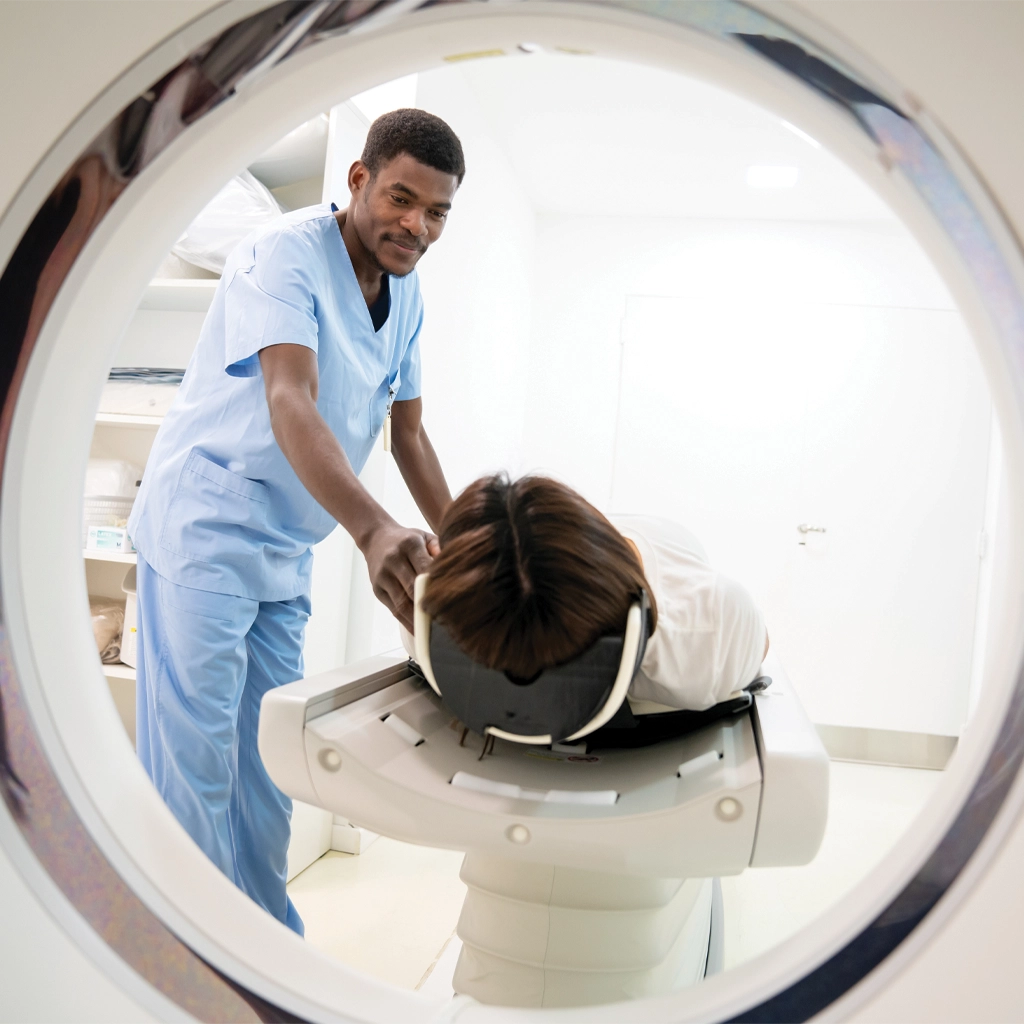

nuclear medicine

Imaging Technique

Nuclear medicine studies involve the administration of a radiopharmaceutical that is designed to localize to specific tissues or organ systems. The distribution of this tracer is then imaged using specialized cameras that detect emitted radiation. The resulting images reflect physiologic activity, allowing for assessment of function, metabolism, or blood flow.

Depending on the study, imaging may be performed over a defined period to evaluate how the tracer is taken up, processed, and cleared. This temporal component is a key feature of nuclear medicine and provides information that is not available through conventional imaging techniques.

Clinical Applications

Nuclear medicine is used in a range of clinical settings where functional assessment is necessary. In oncology, it supports the evaluation of metabolic activity and helps identify disease involvement that may not be fully characterized by structural imaging. It is also used to assess response to treatment by evaluating changes in activity over time.

In cardiac imaging, nuclear medicine is used to evaluate myocardial perfusion and assess the effectiveness of blood delivery to the heart muscle. These studies help identify areas of reduced perfusion and may guide further evaluation or management.

In endocrine imaging, nuclear medicine is commonly used to assess thyroid function and other hormone-related conditions. It allows evaluation of how a gland functions rather than how it appears anatomically.

Nuclear medicine is also used to evaluate bone turnover and other physiologic processes, providing insight into areas of increased or decreased activity that may indicate underlying pathology.

Role in Diagnostic Evaluation

Nuclear medicine is often obtained when additional information is needed beyond what CT, MRI, or ultrasound can provide. Rather than replacing structural imaging, it is typically used alongside it to provide complementary information.

For example, a CT scan may identify a lesion, while nuclear medicine imaging helps determine whether that lesion is metabolically active. Similarly, in cardiac evaluation, structural imaging may demonstrate anatomy, while nuclear medicine provides information about perfusion and function.

This combination of structural and functional imaging supports a more complete assessment, particularly in complex cases where both anatomy and physiology are relevant to clinical decision-making.

Study Selection and Interpretation

The specific nuclear medicine study performed is determined by the clinical question and the organ system being evaluated. Each radiopharmaceutical is selected for its ability to target particular physiologic processes, allowing the exam to be tailored to the indication.

Interpretation focuses on patterns of tracer uptake, distribution, and activity over time. Areas of increased or decreased uptake are evaluated in the context of the clinical presentation and prior imaging findings. This approach allows identification of abnormalities that may not be apparent on structural imaging alone.

Clinical Value

The value of nuclear medicine lies in its ability to provide functional information that complements other imaging modalities. By evaluating how organs and tissues are functioning, these studies offer insight into disease processes that may not be visible through anatomy alone.

In practice, nuclear medicine is relied upon when understanding physiology is essential to diagnosis or management. Its role in oncology, cardiac imaging, and endocrine evaluation makes it an important component of comprehensive imaging.

For more information please visit Cleveland Clinic or Johns Hopkins Medicine.

Contact us today for more information about nuclear medicine procedures, or click below to meet our radiologists.